
Every week Lexigo picks real news stories and retells them in simple English. Read each story, then check the words in bold: they are the ones worth keeping from it. Each story links to the original article if you want to read more.
This week’s words: cap, ranking, winning streak, metadata, investigate, submit, enhance, swirl, candidate, merger, orbit, erupt.
1. Alcaraz wins his first ATP Finals title in Turin
Sports
Carlos Alcaraz beat Alexander Zverev in the ATP Finals final in Turin, winning 6-2, 7-6 (7) and claiming his first title at the event. Zverev entered as the new world No 1, but Alcaraz’s victory showed that the top ranking did not settle who was playing best. The win capped a strong season for Alcaraz, 23, who had missed four and a half months with a wrist injury and also faced a thigh problem during the tournament. He finished the year on a 14-match winning streak.
Source: The Guardian
| Word | Level | Meaning |
|---|---|---|
| cap (verb) | C1 | to bring an event or period to a successful end |
| ranking (noun) | B2 | a position in a list that shows how good or successful someone is |
| winning streak (noun phrase) | B2 | a series of repeated successes or victories |
2. Nicalis removes AI music from The Binding of Isaac: Repentance+
Photo: StartupStockPhotos / Pixabay
Gaming
Nicalis removed AI-generated music from The Binding of Isaac: Repentance+ after players found it in a recent update and criticized the game in Steam reviews. The tracks appeared in a daily run themed around Grand Theft Auto 6. A Reddit user said metadata pointed to Suno as the music tool. Creator Edmund McMillen said he had not known the tracks were included and was investigating how they were added. Nicalis later said a new build removed the music and fixed other issues. The PC patch was live, while console builds had been submitted to Microsoft, Nintendo, and Sony.
Source: Eurogamer
| Word | Level | Meaning |
|---|---|---|
| metadata (noun) | C1 | information stored with a file that describes its contents or origin |
| investigate (verb) | B1 | to try to discover the facts about something |
| submit (verb) | B2 | to send something for consideration or approval |
3. Juno image shows colorful clouds on Jupiter
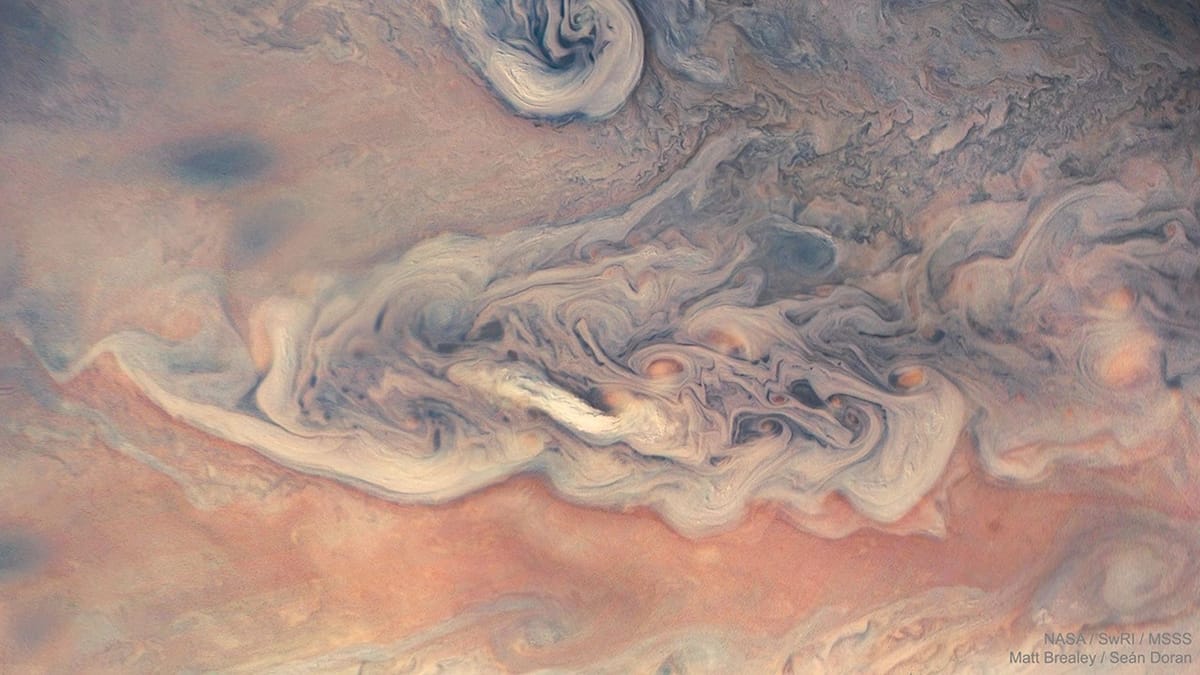
Image: NASA
Space
NASA’s Astronomy Picture of the Day shows a color-enhanced image of Jupiter taken by the Juno spacecraft in 2018, during its 14th close pass over the planet. Light clouds swirl around reddish areas, while lighter clouds cover some darker ones. Scientists still do not know for certain what gives Jupiter’s clouds their colors. The planet’s thick atmosphere is mostly hydrogen and helium, which have no color at the cold tops of the clouds. Small amounts of ammonium hydrosulfide are one leading candidate. Juno still passes close to Jupiter every 33 days, studying a different area on each trip.
Source: NASA Science
| Word | Level | Meaning |
|---|---|---|
| enhance (verb) | B2 | to improve the quality or strength of something |
| swirl (verb) | C1 | to move around quickly in circles |
| candidate (noun) | B2 | a person or thing that is considered a possible choice for something |
4. Webb observes a stellar merger in Andromeda

Photo: Hans / Pixabay
Science
Astronomers used NASA’s James Webb Space Telescope and years of other measurements to study a stellar merger in the Andromeda galaxy. A star slightly less massive than the Sun spiraled into a huge supergiant near the galaxy’s outer edge. The pair had orbited one another for thousands of years. After the smaller star entered the supergiant’s outer atmosphere, they completed their union in seven more orbits, about seven years. The resulting star, nicknamed Bao, may have been rejuvenated. The system erupted in 2025; Webb observed it 47 days after the peak.
Source: ScienceDaily
| Word | Level | Meaning |
|---|---|---|
| merger (noun) | C1 | the joining of two things to form one |
| orbit (verb) | B2 | to move around a planet, star, or other object in space |
| erupt (verb) | B2 | to suddenly throw out light, gas or other material with great force |
How to keep these words
Reading a word once is a start; seeing it again tomorrow is what makes it stay. Pick the three or four words you’d actually use, write one sentence of your own with each, and look at them again the next day. Here is why the next day matters.
With a free Lexigo account, the stories in your weekly newsletter come at your level, on the topics you pick, and use the words you saved.